
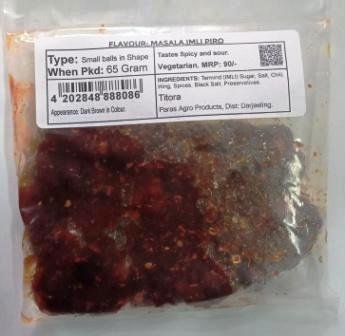
Description
Masala Imli Piro Titaura
The Beloved Spiced Tamarind Candy of the Northeast Himalayan Foothills
Introduction
Along the misty foothills and vibrant market lanes of the northeast Himalayan regions of India — stretching from the Himalayan hills through Sikkim and into the lower valleys of Assam and Arunachal Pradesh — there exists a humble yet iconic treat that has charmed generations of snack lovers. Known locally as Piro Titaura, the spiced tamarind version, Masala Imli Piro Titaura, stands as one of the most cherished tangy-spicy confections of this mountain belt.
Image | Details |
|---|---|
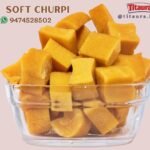
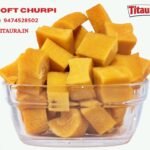
 | Chini Pata Titaura, a classic sweet variety loved for its… 1Available ₹360.00 |
 | |
 | |
 | |
 | |
 |
Traditional Snack Culture

Historical and Cultural Roots
The art of making titaura is believed to have been practiced for centuries across the Himalayan foothills, with its origins rooted in both indigenous food preservation techniques and cross-cultural trade influences. The northeast Himalayan regions of India, with their unique blend of Tibetan, Lepcha, Gorkha, Sikkimese, and Assamese culinary traditions, created the perfect cultural soil for this candy to evolve.
Tamarind, while not native to the Himalayan highlands, found its way into this region through the ancient trade routes that connected the plains of Bengal and Bihar with the mountain communities. Local artisans began combining tamarind pulp with indigenous spices — timur (Sichuan pepper), dried ginger, cumin, black salt, and red chili — giving birth to the distinct masala variant that defines Piro Titaura today.
In the hill towns titaura makers — often women working from their homes — became a cornerstone of the local snack economy. Their handcrafted rolls and dried slabs were sold in small packets from roadside stalls, school canteens, and weekly haats (markets), becoming as much a part of the cultural fabric as the local tea gardens themselves.
Key Ingredients
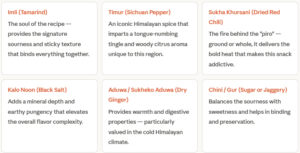
What sets Masala Imli Piro Titaura apart from ordinary tamarind candies is its carefully layered spice profile. Each ingredient plays a distinct role:
Imli (Tamarind) The soul of the recipe — provides the signature sourness and sticky texture that binds everything together.
Timur (Sichuan Pepper) An iconic Himalayan spice that imparts a tongue-numbing tingle and woody citrus aroma unique to this region.
Sukha Khursani (Dried Red Chili) The fire behind the “piro” — ground or whole, it delivers the bold heat that makes this snack addictive.
Kalo Noon (Black Salt) Adds a mineral depth and earthy pungency that elevates the overall flavor complexity.
Aduwa / Sukheko Aduwa (Dry Ginger) Provides warmth and digestive properties — particularly valued in the cold Himalayan climate.
Chini / Gur (Sugar or Jaggery) Balances the sourness with sweetness and helps in binding and preservation.
The Traditional Preparation Process
Making Masala Imli Piro Titaura is a labor of love that requires patience and a practiced hand. The process begins with soaking raw tamarind pods in warm water until the pulp softens and separates easily from the seeds and fibers. The extracted pulp is then strained to a smooth, thick paste.
The masala — a dry blend of timur, red chili powder, black salt, dry ginger, cumin, and sometimes a pinch of turmeric — is freshly ground on a stone mill or in a mortar and pestle. Freshly ground spices are considered essential; pre-mixed commercial blends are frowned upon by traditional makers who believe the aroma dissipates quickly once ground.
Sugar or jaggery is cooked with the tamarind paste on a low flame, stirring constantly until it thickens to a pliable, non-sticky consistency. The masala blend is then folded in progressively — not all at once — to ensure even distribution. Some makers add a final dusting of spice powder over the formed titaura pieces for an extra layer of surface heat.
The prepared mixture is spread thin on greased trays or banana leaves and left to sun-dry for one to three days depending on weather conditions. Once semi-dried to the ideal chewy texture, it is cut into small rectangles, rolled into spirals, or formed into balls before a final brief sun-drying. The finished product is firm on the outside, chewy within, intensely flavored, and shelf-stable for weeks.
Regional Variations Across the Northeast Himalayan Belt
While the core recipe remains consistent, distinct regional variations have emerged across the northeast Himalayan foothills that reflect local tastes and ingredient availability:
Sikkim’s Terai and River Valleys: Makers here occasionally blend local wild plum or lapsi (Choerospondias axillaris) with tamarind, creating a more complex sourness. The sugar content is slightly higher, resulting in a more candy-like sweetness balancing the heat.
Assam Foothills: In the lowland-influenced markets near the Himalayan foothills of Assam, titaura makers sometimes incorporate mustard-infused oil as a surface rub, giving it a pungent edge not found elsewhere. The texture is slightly more moist and soft.
Arunachal’s Border Markets: Here, wild jungle spices and locally sourced chilies of exceptional heat find their way into the masala blend, producing a version of Piro Titaura that is perhaps the fiercest in the entire region — not for the faint-hearted.
Cultural Significance and Social Fabric
Titaura is far more than a snack in the northeast Himalayan regions — it is a cultural symbol. For many who grew up in these hill communities, the taste of Piro Titaura is inseparable from memories of school days, festival mornings, and the company of grandmothers who kept small tins of it on kitchen shelves.
During festivals like Dasain, Tihar, Losar, and Bihu, homemade titaura is often prepared in large quantities and distributed among relatives and neighbors. It features prominently in the informal hospitality of hill households — a piece of titaura offered with tea is a gesture of warmth and welcome.
The making and selling of titaura has also been an important source of livelihood for women in the hills. Many small home-based enterprises run by women have grown over the decades into recognized cottage industry units, supplying titaura to towns across the foothills and even to diaspora communities in distant cities who seek a taste of home.
Nutritional and Digestive Properties
Beyond its bold flavor, Masala Imli Piro Titaura has long been valued in traditional folk medicine and dietary wisdom. Tamarind is rich in tartaric acid, which aids digestion and has antioxidant properties. Combined with the digestive benefits of ginger and the carminative properties of cumin and timur, Piro Titaura functions as a natural digestive after heavy meals — a purpose it is still deliberately used for in many households.
Black salt, another key ingredient, is traditionally believed to support digestive health and reduce bloating. The small portions in which titaura is consumed — a few pieces at a time — mean the sugar and salt content remains moderate, making it a sensible indulgence compared to many modern packaged snacks.
Titaura in the Modern Era
In recent years, Masala Imli Piro Titaura has transcended its humble street-food origins and entered the mainstream snack market of the northeast Himalayan region. Small-scale producers in Dibrugarh now package titaura in branded pouches sold in supermarkets, online platforms, and gift hampers marketed to the Indian diaspora abroad.
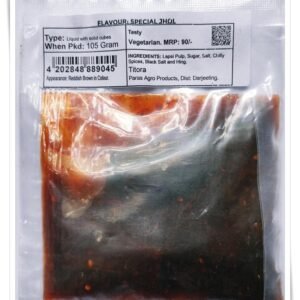
Food entrepreneurs from the hills have begun experimenting with variations — chocolate-coated titaura, low-sugar versions for health-conscious consumers, and even Jhol titaura chutneys bottled for cooking use. Food bloggers and YouTubers from the region have given Piro Titaura significant digital attention, introducing it to audiences far beyond its native foothills.
However, purists maintain that no factory-made product replicates the depth of sun-dried, hand-rolled, stone-ground masala titaura made in small batches at home. The debate between traditional craft and commercial scale is ongoing — much as it is with artisanal foods everywhere — but the demand for authentic Piro Titaura shows no sign of waning.
Preservation and the Way Forward
Efforts to document and promote the titaura-making tradition are gaining momentum in the northeast Himalayan regions. Cultural organizations, local food festivals, and state government artisan promotion schemes have begun recognizing titaura making as a craft worthy of preservation.
The story of Masala Imli Piro Titaura is ultimately a story about the intersection of geography, culture, and taste. It is a product that could only have come from this particular landscape — where the tang of tamarind meets the fire of Himalayan spice, where trade routes crossed mountain passes, and where communities learned to preserve the best of their harvests in small, potent, sun-dried morsels of joy.
Conclusion
Masala Imli Piro Titaura is not merely a candy — it is a cultural artifact, a livelihood, a medicinal tradition, and a shared sensory memory of the northeast Himalayan foothills of India. From the damp bazaars to the river-valley markets of Sikkim and the tribal border towns of Arunachal Pradesh, this spiced tamarind delight continues to bind communities together through a taste that is unmistakably, irreplaceably, of the mountains.


Sneha Poudel –
The taste of home! Titaura never fails to lift my mood.
Sunita Raut –
Can’t stop eating Titaura once I start. It’s too good!